Technology
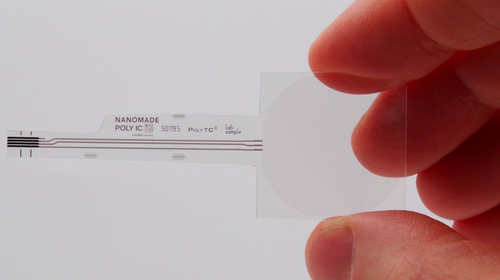
One of the most sensitive strain sensor technologies in production on the market today, Nanomade sensor’s characteristics ensure tailor-made solutions for each project.
Ultra-thin
Flexible
Ultra-sensitive
Transparent
Industrialised

Highly sensitive strain sensing
Nanomade sensors are among the most advanced force, strain, and touch detection technologies currently in production. Ultra-thin, flexible, and highly customizable, our sensors provide a seamless integration into a variety of materials, including metal, plastic, glass, and fabric. With their high sensitivity and robust durability, they are designed to meet the demanding requirements of industries ranging from aerospace and automotive to medical and industrial applications.
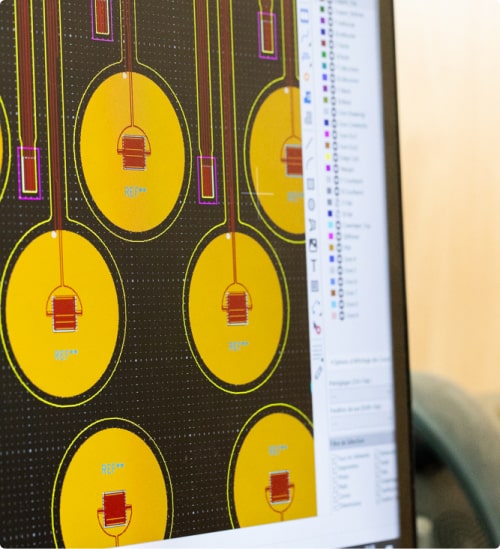
1 material + 1 sensor = 3 applications
Nanomade develops and manufactures highly sensitive, ultra-thin, flexible and customisable deformation sensors. Our revolutionary sensors are applied in three key areas, offering unprecedented potential in all industrial sectors, including the performance demanding automotive and aerospace industries.
Force & Touch
Transformation of any surface into an interactive interface by detecting both force and touch, revolutionising interaction with everyday objects.
Learn MorePulse Monitoring
Detection of micro-deformations of the human body for real-time monitoring of vital signs, offering potential for remote medical monitoring and connected healthcare.
Learn MoreStructure Monitoring
Deformations and impacts detection on various structures and materials, crucial for industries where reliability, accuracy, and safety are paramount.
Learn MoreCompatible with all materials
Nanomade sensors are compatible with any and all materials, offering adaptability across various surfaces. Whether it’s metal, plastic, wood, or fabric, our technology seamlessly integrates to provide reliable and precise measurements in any material environment.
Metal
Wood
Textile
Carbon Fiber
Plastic
Glass
An Industrial Solution Built for Performance
Nanomade’s innovative sensors combine high precision with extreme durability, making them suitable for the toughest environments. Designed to meet aerospace and automotive industry standards, they offer unparalleled performance in harsh conditions while maintaining exceptional responsiveness.
Market-Leading Sensitivity
Our strain and force sensors capture even the most subtle deformations, providing real-time, high-precision measurements for a variety of applications.
Tested for
Reliability
The sensors have been subjected to over 10 million strokes and have successfully passed rigorous temperature and humidity testing (-40ºC to +120ºC), ensuring compliance with industry standards.
Scalable
Manufacturing
We offer a multi-tiered production strategy to meet different volume requirements, from early prototyping to full-scale mass production.
An unique innovation
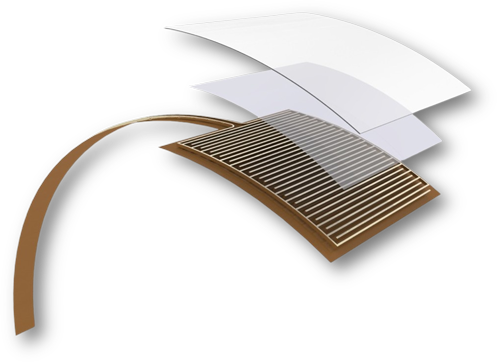
Nanomade technology is based on the deposition of a strain-sensitive ink on flexible substrates.
More specifically, Nanomade strain sensors consist of a proprietary conductive ink containing nanoparticles deposited between interdigitated conductive electrodes on an insulating flexible substrate.
Quantum tunnelling
Nanomade’s strain sensor technology is based on quantum tunneling, a unique phenomenon where electrons jump between conductive nanoparticles separated by tiny gaps.
When the material stretches, these gaps widen, reducing electron flow and increasing resistance. When compressed, the gaps shrink, allowing more electrons to pass, lowering resistance. This results in extreme sensitivity to even the smallest mechanical changes.
Thanks to this advanced nanoparticle ink, Nanomade’s sensors deliver unmatched precision across various industries.

Applicable in all industries
Nanomade sensors are designed with adaptability in mind, making them suitable for a wide range of industries. Whether in automotive, healthcare, or beyond, our technology offers tailored solutions to meet the unique requirements of each sector, ensuring optimal performance and reliability.
We’re well protected
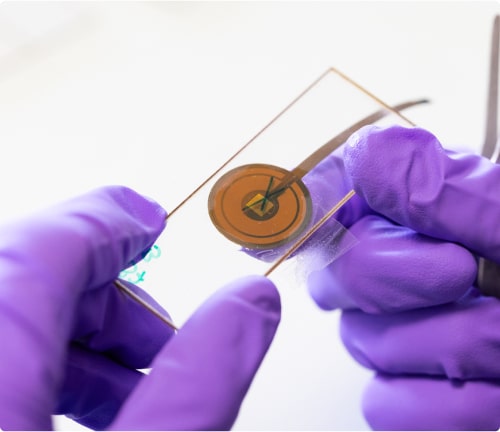
Nanomade has built a strong intellectual property portfolio, with 20 patents filed to date and a continuous innovation process that leads to the generation of 1 to 2 new patents every year. These patents focus on the unique integration of Nanomade’s sensors to ensure optimal performance across various applications, from touch and force detection to strain sensing.
While the specific formulation of the nanoparticle-based ink remains a closely guarded industrial secret, the patented methods ensure seamless integration, reliability, and high sensitivity in diverse environments. This commitment to innovation strengthens Nanomade’s technological leadership and ability to deliver cutting-edge solutions.
Awards









They trust us








Our News





FAQ
What is Nanomade technology?
Nanomade develops ultra-sensitive deformation sensors that can turn every material into smart and interactive surfaces. The technology can detect micro-deformations, pressure, gestures, and mechanical variations on any shapes and on a wide range of surfaces.
What is the principle behind Nanomade technology?
Nanomade technology is based on quantum physics properties, particularly the tunneling effect at atomic level. This principle enables a very high level of sensitivity to deformation, which is difficult to achieve with conventional sensing technologies.
Which materials can be made interactive?
Nanomade technology can be integrated beneath many different materials, including metal, plastic, wood, leather, glass, and other surfaces. It enables to make objects interactive without compromising design or reliability.
How is Nanomade different from standard capacitive technology?
Unlike traditional capacitive technology (which is limited to proximity or contact detection and fails with metallic surfaces, gloves, or humidity), Nanomade’s technology measures material micro-deformation. This allows our sensors to work seamlessly with any material, even when using gloves or in humid environments. Furthermore, Nanomade sensors detect the exact level of applied force. When combined with haptic feedback, this enables a much more natural user experience: the haptic response is directly proportional to the force applied, whereas capacitive technology is restricted to a simple binary (on/off) trigger.
How sensitive are Nanomade sensors?
Nanomade sensors are designed to detect micro deformation (down 0.001%). Compared with standard strain gauge it is 75 times more sensitive.
What types of gestures can be detected?
Depending on the application, the technology can detect different interactions such as press, tap, long press, swipe, jog, slider control, wear detection and pattern on any type of material.
What are Nanomade’s main application markets?
Nanomade focuses on three main application markets: Human-Machine Interfaces, also known as HMI; health monitoring and robotics.
Does the technology work with gloves?
Yes, Nanomade’s technology works with gloves, exposure to humidity, and dusty environments which is a possible advantage for HMI applications. This is especially relevant for automotive, industrial, and outdoor use cases.
Is Nanomade technology ready for volume production?
Yes. Nanomade has a 500 m² laboratory and production line, with capabilities in sensitive ink production, sensor design, prototyping, mechanical testing, and environmental testing.
How does a project with Nanomade typically work?
A project generally follows three steps:
- Evaluation with standard sensors or a development kit,
- Proof of concept with customized sensor design (typically lasts around three months),
- Industrialization and go-to-market.